Spider Lily (Hymenocallis littoralis)
Naming Identity
The scientific name for bunga bakung in Latin is Hymenocallis littoralis. Internationally, this plant is known in English as the spider lily or beach spider lily.
In Indonesia, this plant has many local names. Among them are "bahong" in Medan, North Sumatra, " bawang Tembaga" or " kajang-kajang" in Palembang, " Semur" in Bangka, and " Bakueng" in Padang.
The genus name, Hymenocallis, is derived from the combination of two Greek words: "hymen," meaning membrane, and " callos," meaning beauty. Hymenocallis, thus, means "beautiful membrane." This name refers to the thin membrane that connects the filaments of the flower.
Taxonomy
| Kingdom | Plantae |
|---|---|
| Phylum | Tracheophyta |
| Class | Magnoliopsida |
| Order | Asparagales |
| Family | Amaryllidaceae |
| Genus | Hymenocallis |
| Species | Hymenocallis littoralis |

Origin
Spider lilies originate from tropical America, including Mexico, northern Peru, and Brazil. They have since spread to various regions in Asia, including Indonesia, India, the Philippines, India, Bangladesh, and Sri Lanka, as well as other countries in the Americas and Africa, such as Angola, the Central African Republic, Zambia, Tonga, Suriname, Samoa, Ecuador, Fiji, and the Cook Islands (Hymenocallis Littoralis (Jacq.) Salisb. | Plants of the World Online | Kew Science, 2023).
Morphology
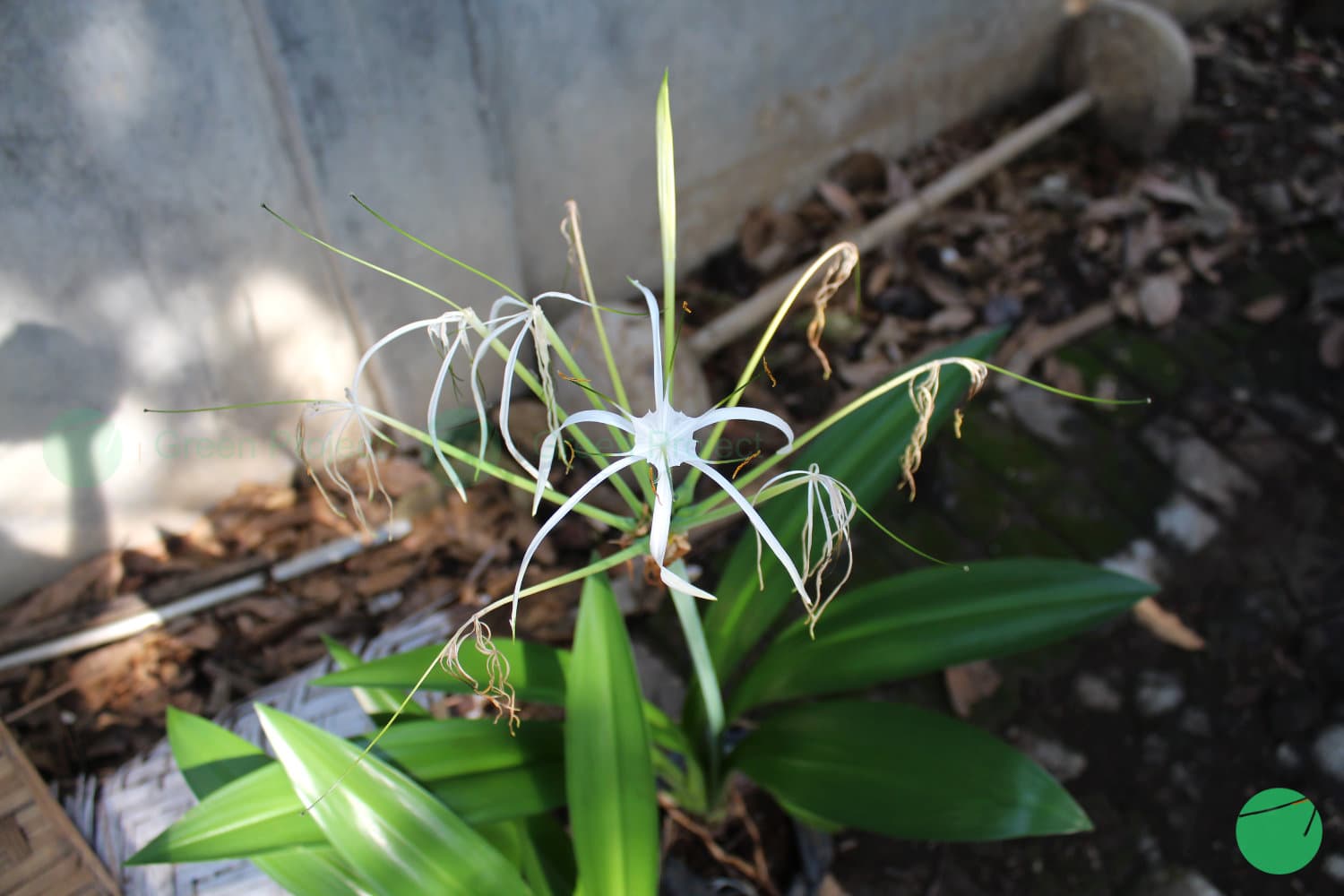
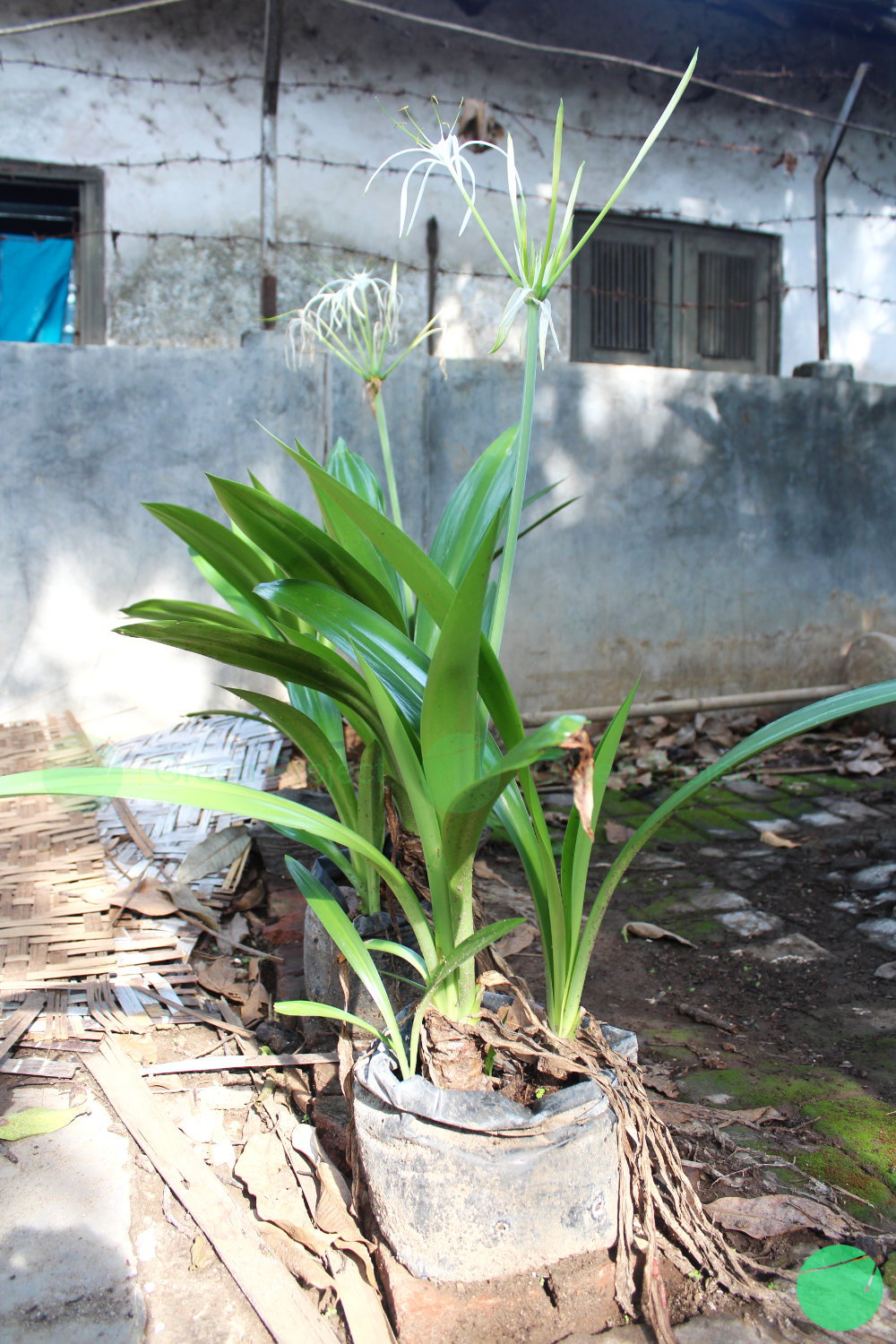
Spider lily is a herbaceous plant that can grow to a height of 60 to 90 cm. Its long, sickle-shaped leaves, green in color and glossy, are approximately 45 to 60 cm long and 2.5 to 5 cm wide.
Another striking characteristic of this plant is its star-shaped flowers, approximately 15 to 20 cm in diameter. They are white with a yellow center. Each flower tube is approximately 14 to 17 cm long.
Spider lily has a fragrant, vanilla-like scent and grows from its stems. This plant generally thrives in direct sunlight, but it can also thrive in slightly shaded areas. It also requires loose, moist soil with a neutral pH (UMMI Biology Laboratory - Hymenocallis littoralis, 2023).
Health Benefits and Other Uses
In Indonesia, spider lilies are generally used as ornamental plants, primarily due to their unique flower shape and fragrant aroma. However, many also utilize the compounds found in this plant in various traditional medicines. Some of the compounds found in lilies include alkaloids, flavonoids, saponins, tannins, steroids, and fatty acids.
In Indonesia, this plant is not only commonly used as an ornamental plant but also as an ingredient in traditional medicine to treat headaches and fevers. Meanwhile, in its native Mexico, spider lilies, known as azucena de mar or lirio de mar, are used to treat various digestive problems and fevers (UMMI Biology Laboratory - Hymenocallis littoralis, 2023).
In Malaysia, spider lilies are used as a medicinal ingredient in traditional medicine for wound healing through methanol sonication extracts of the bulbs, flowers, roots, anthers, and stems (Sundarasekar J; Sahgal G; Murugaiyah V; Lay LK; Thong OM; Subramaniam S, 2018).
Not only has its traditional use been tested, through several observations it was also found that the methanol extract of spider lily has also been proven to show antimicrobial activity that inhibits the growth of E. coli and Staphylococcus aureus and has good antioxidant, antimicrobial and antibiofilm properties (Zhang et al., 2022).
Location
Morphology
ACIR Community. (2023). Usda.gov. https://acir.aphis.usda.gov/s/cird-taxon/a0ut0000000r9swAAA/hymenocallis-littoralis
Hymenocallis littoralis (Jacq.) Salisb. | Plants of the World Online | Kew Science. (2023). Plants of the World Online. https://powo.science.kew.org/taxon/urn:lsid:ipni.org:names:30048918-2
Laboratorium Biologi UMMI - Hymenocallis littoralis. (2023). Laboratorium Biologi UMMI - Hymenocallis littoralis. Google.com. https://sites.google.com/ummi.ac.id/laboratoriumbiologi/identifikasi-tumbuhan/hymenocallis-littoralis
Sundarasekar J;Sahgal G;Murugaiyah V;Lay LK;Thong OM;Subramaniam S. (2018). Report: Wound healing activity of Hymenocallis littoralis - Moving beyond ornamental plant. Pakistan Journal of Pharmaceutical Sciences, 31(6). https://pubmed.ncbi.nlm.nih.gov/30473529/
Zhang, J., Sousath Sayakoummane, Soo Ah Kim, Jong Sub Lee, Eui Su Choung, Eun Sil Kim, Lee, S.-G., Yum, J., Lee, B.-H., Lee, S., Ji Hye Kim, & Jae Youl Cho. (2022). Hymenocallis littoralis ameliorates inflammatory responses in LPS-stimulated RAW264.7 cells and HCl/EtOH-induced gastric mucosal injury via targeting the MAPK pathway. Journal of Ethnopharmacology, 295, 115400--115400. https://doi.org/10.1016/j.jep.2022.115400