What is Eco-Enzyme and How to Make It?

What is Eco-Enzyme?
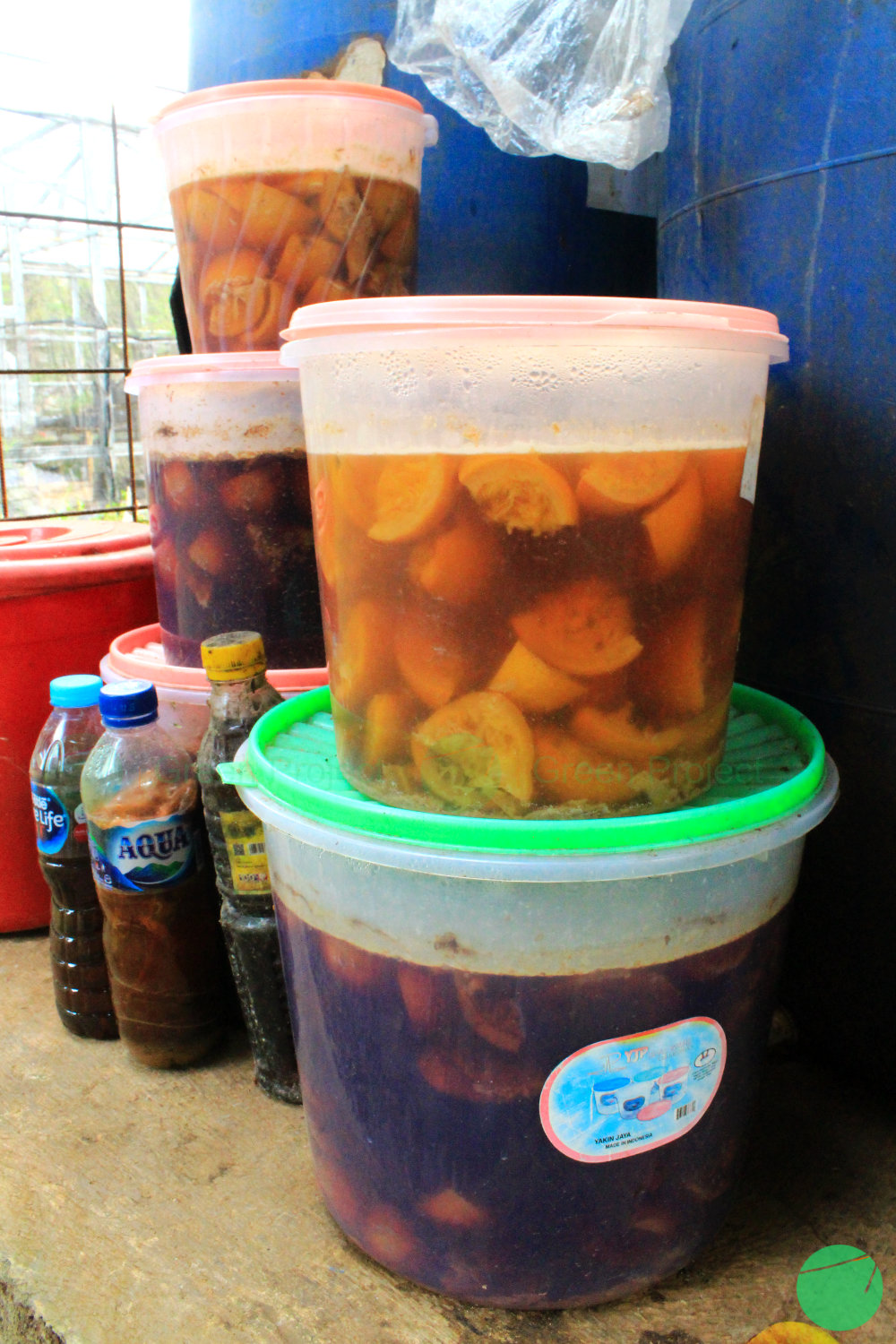
Eco-enzyme is a liquid produced through the fermentation of organic waste, such as vegetable scraps, fruit peels, and sugar. It is typically brown in color and possesses a strong, sweet-and-sour fermented aroma.
Microscopic observations reveal that eco-enzyme contains a liquid dominated by propagules resembling fungal or mold hyphae, with a pH range of 3–4, indicating a fairly acidic nature (admin, 2022).
According to Benny et al. (2023), fruit peels—particularly citrus peels—and vegetables such as tomatoes are the best organic materials for producing eco-enzyme, as they are rich in organic acids.
Uses
Eco-enzymes are multipurpose substances, commonly utilized as organic fertilizer in agriculture, plantations, and livestock farming, as well as in medicinal applications and as floor-cleaning agents. Furthermore, eco-enzymes are also said to have applications for the human body—for instance, as a mouthwash, a remedy for preventing skin fungus and eczema, and even as a treatment for dental tartar (admin, 2022).
Benefits
Its use in various environmental applications is driven not only by its low cost and the easy availability of its ingredients, but, more importantly, by its scientifically proven benefits. These include its efficacy as a disinfectant and antifungal agent, its ability to purify the air by removing bacteria, its role in promoting plant growth, and its application in treating metal-laden wastewater—a growing issue resulting from increased industrialization.
Eco-enzymes, produced from various citrus peels, are used for wastewater treatment, such as in rivers that have become contaminated due to waste disposal (Benny et al., 2023). When introduced into water systems, the residual enzymes can travel underground, ultimately helping to purify rivers and oceans (What Is Eco Enzyme? | 环保酵素 Enzyme SOS, 2014).
How to Make It?
Making eco-enzymes is quite simple and economical, as the required ingredients are generally household waste. Below are the necessary materials and the preparation process.
Tools and materials
- Fruit peels
- Brown sugar (palm sugar)
- Water
- A plastic storage container (such as a jar or bin). Using plastic is recommended to prevent the container from bursting once gas begins to form.
Preparation process
- Measure the water, fruit peels, and brown sugar using a ratio of 10:3:1 (e.g., 100 grams of water, 30 grams of fruit peels, and 10 grams of brown sugar).
- Chop the fruit peels into small pieces.
- Combine and mix all the ingredients in the container, seal it tightly, and leave it to ferment for 3 months in a sheltered, protected spot.
- During the initial stage of fermentation, open the container lid approximately once a week to release built-up gas and prevent the container from bursting.
- After 3 months, the resulting eco-enzyme liquid should be dark brown with a strong, acidic odor. If the liquid appears black, add more sugar to continue the fermentation process.
- Do not be concerned if you see worms or insects; they will decompose during the fermentation process.
- Strain the liquid to remove any remaining organic waste, then store it in a container for future use.
How to Use It?
Not only is the production process simple, but its application is also very straightforward. As a residual liquid, eco-enzyme can be added to various other organic materials, depending on its intended use. However, it is important to pay attention to the specific dosage for each application.
A mixture of 1 liter of water and 1 milliliter of eco-enzyme can be used as a fertilizer, while a bucket of water mixed with one capful of eco-enzyme can be used as a floor cleaner (prasetya1, 2023).
Bibliography
admin. (2018, December 31). Eco-Enzyme: Multipurpose Liquid from Organic Waste - Waste4Change. Waste4Change. https://waste4change.com/blog/eco-enzyme-multipurpose-liquid-from-organic-waste/#:~:text=Eco%20enzyme%20or%20garbage%20enzyme,insect%20repellent%20and%20plant%20fertilizer.
admin. (2022, October 5). Mengenal Ekoenzim dan Manfaatnya - Dinas Pertanian dan Ketahanan Pangan Provinsi Bali. Dinas Pertanian Dan Ketahanan Pangan Provinsi Bali. https://distanpangan.baliprov.go.id/mengenal-ekoenzim-dan-manfaatnya/
Benny, N., Shams, R., Kshirod Kumar Dash, Vinay Kumar Pandey, & Bashir, O. (2023). Recent trends in utilization of citrus fruits in production of eco-enzyme. Journal of Agriculture and Food Research, 13, 100657--100657. https://doi.org/10.1016/j.jafr.2023.100657
prasetya1. (2023, July 25). MMD Introduces Eco Enzyme as a Solution for Household Waste | Prasetya UB. Prasetya UB. https://prasetya.ub.ac.id/en/mmd-kenalkan-eco-enzyme-sebagai-solusi-limbah-organik-rumah-tangga/
What is Eco Enzyme? | 环保酵素 Enzyme SOS. (2014). Enzymesos.com. https://www.enzymesos.com/what-is-eco-enzyme