Billy Goat Weed (Ageratum conyzoides)
Name
Scientifically, bandotan is known by its Latin name, Ageratum conyzoides. Internationally, in English, this plant is commonly referred to as "billy goat weed," "blue-flowered groundsel," "blue top," or "mother brinkley."
In Indonesia, besides being called bandotan, the plant is also known as berokan, dus-bedusan, or wedusan. In Malaysia, it is commonly known as rumput pereh jarang, rumput sekedok, or tahi anjing. In the Philippines, it is called aspukpuk or bahu-bahu, while in India, it is known as gundhaubon or mahakaua.
The genus name, Ageratum, is derived from the Greek "a" (meaning "not") and "geras" (meaning "old age"), referring to the plant's long-lasting flowers. The specific epithet, conyzoides, alludes to the species' resemblance to the genus Conyza. Its common international name, "billy goat weed," refers to the pungent odor emitted by the plant, which resembles the smell of a male goat (J. Vélez-Gavilán, 2022).
Taxonomy
| Kingdom | Plantae |
|---|---|
| Phylum | Tracheophyta |
| Class | Magnoliopsida |
| Order | Asterales |
| Family | Asteraceae |
| Genus | Ageratum |
| Species | Ageratum conyzoides |
Origin
The exact origin of the bandotan plant remains uncertain; however, it most likely originated in Central and South America. Today, the plant can be easily found in almost every part of the world.
The species Ageratum conyzoides—known in Indonesia as bandotan—is considered the first species of the genus Ageratum to be cultivated in Europe, having been recorded in Belgium prior to 1697. Early records of its cultivation also exist for England (before 1714) and Sweden (1748). It is likely that the plant was introduced to the Philippines via galleons sailing from Mexico to Manila (J. Vélez-Gavilán, 2022).
Invasive Nature
Ageratum conyzoides (known locally as 'bandotan') is now considered an invasive weed, particularly in agricultural lands. This plant has been classified as an invasive weed across Asia—especially in Southeast Asia—as well as in Africa, Australia, Hawaii, and the United States.
Morphology
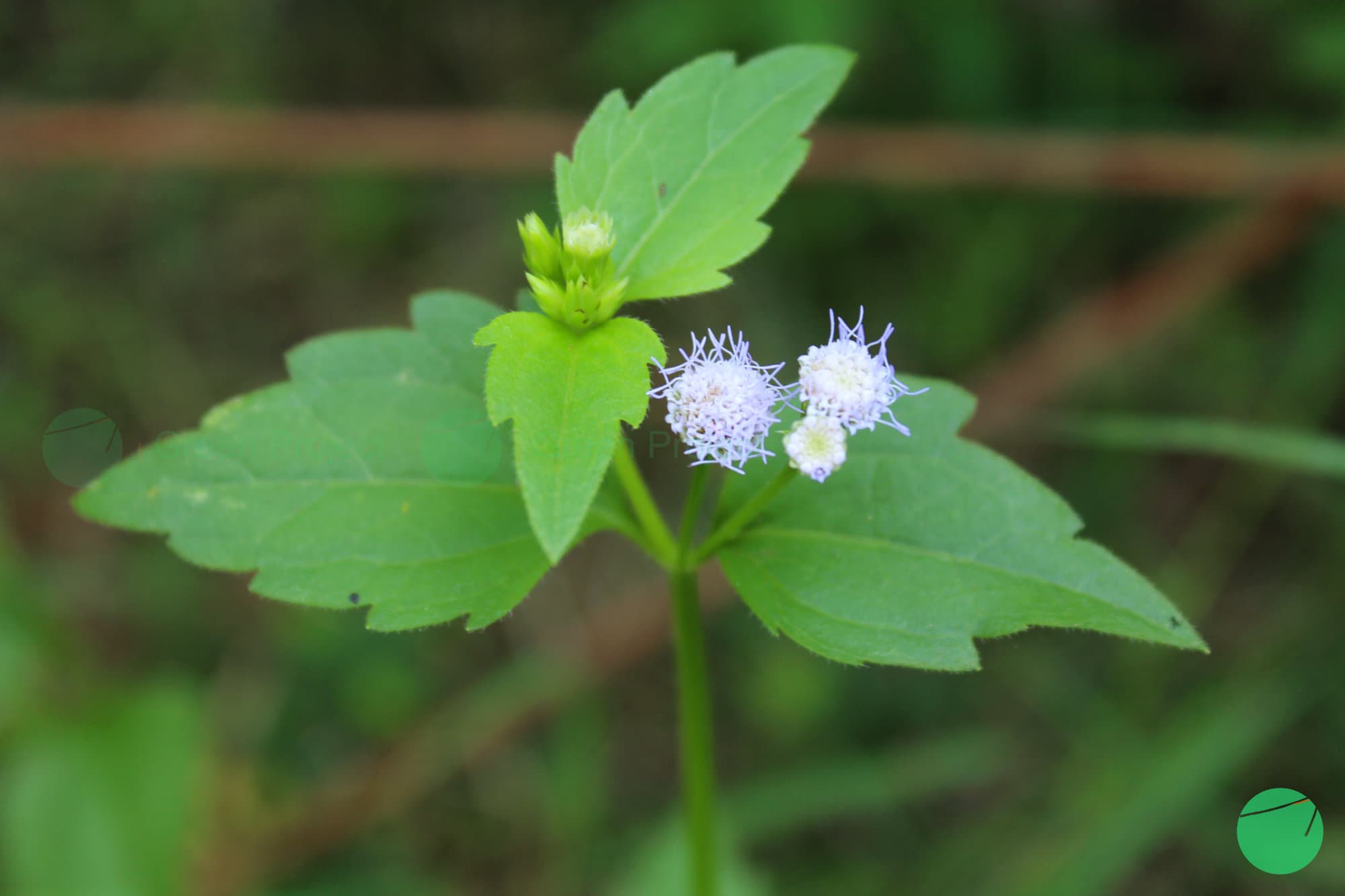
Bandotan is an erect, branching herbaceous plant that can reach a height of 50 to 1500 mm. It has cylindrical stems that become woody as the plant matures; when young, the stems are covered in short, white hairs.
The leaves grow in opposite pairs and measure approximately 20 to 100 mm in length and 5 to 50 mm in width. Each leaf is attached to a hairy petiole (leaf stalk) that is 5 to 75 mm long. The green leaves are broadly ovate—shaped like a rounded egg—with a tapered base and serrated (toothed) margins. When crushed, the leaves emit a pungent odor reminiscent of a male goat.
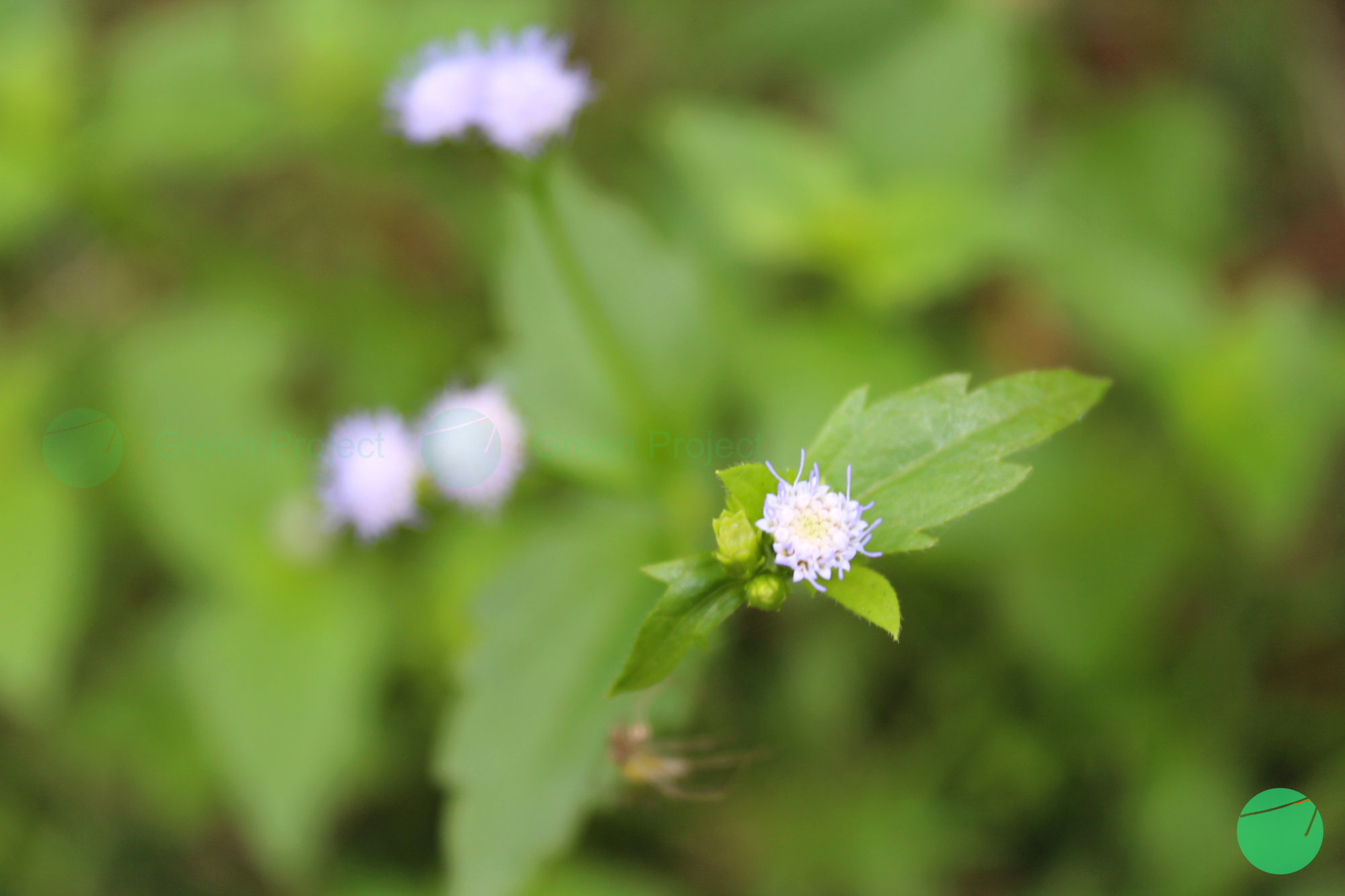
The inflorescence is branched and appears either terminally (at the tips of stems) or in the leaf axils, consisting of 4 to 18 flower heads arranged in a conspicuous, flat-topped cluster. The flower heads—which can be light blue, white, or purple—are borne on stalks measuring 50 to 150 mm in length and 5 mm in width.
Health Benefits and Other Uses
Although now classified as an invasive plant, Ageratum conyzoides (locally known as bandotan) remains useful as a medicinal species in various traditional healing practices. Its medicinal value has also been supported by numerous scientific studies.
Scientific literature indicates that A. conyzoides can aid in the treatment of incised wounds, thanks to its anti-inflammatory properties. This is primarily due to the presence of secondary metabolites—specifically flavonoids and alkaloids—that exert anti-inflammatory effects. Other compounds found in this species include tannins, polyphenols, steroids, triterpenoids, monoterpenoids, and various other terpenoids (Sutjiatmo et al., n.d.).
In Africa, this plant has long been used in traditional herbal medicine, serving as a laxative, an antipyretic (fever reducer), a remedy for gastric ulcers, and a dressing for wounds (Diallo et al., 2014).
Beyond its medicinal applications, A. conyzoides is also used as fodder for livestock, including cattle, horses, and goats, as well as for laboratory animals like guinea pigs (J. Vélez-Gavilán, 2022).
Despite its widespread use in traditional medicine, it is important to note that A. conyzoides also contains toxic compounds known as pyrrolizidine alkaloids (Bosi et al., 2013). Research by Diallo et al. (2014) found that, at doses of 500 and 1000 mg/kg, A. conyzoides can cause liver, kidney, and hematological (blood-related) disorders.
Location
Bibliography
ACIR Community. (2024). Usda.gov. https://acir.aphis.usda.gov/s/cird-taxon/a0ut0000000rBauAAE/ageratum-conyzoides
Bosi, C. F., Rosa, D. W., Grougnet, R., Nikolaos Lemonakis, Halabalaki, M., Alexios Leandros Skaltsounis, & Biavatti, M. W. (2013). Pyrrolizidine alkaloids in medicinal tea of Ageratum conyzoides. Revista Brasileira de Farmacognosia, 23(3), 425--432. https://doi.org/10.1590/s0102-695x2013005000028
Diallo, A., Kwashie Eklu-Gadegbeku, Koffi Amegbor, Amegnona Agbonon, Kodjo Aklikokou, Creppy, E., & Messanvi Gbeassor. (2014). In vivo and in vitro toxicological evaluation of the hydroalcoholic leaf extract of Ageratum conyzoides L. (Asteraceae). Journal of Ethnopharmacology, 155(2), 1214--1218. https://doi.org/10.1016/j.jep.2014.07.005
J Vélez-Gavilán. (2022). Ageratum conyzoides (billy goat weed). CABI Compendium. https://doi.org/10.1079/cabicompendium.3572
Sutjiatmo, A., Edriayani, N., Mulyasari, T., Hermanto, F., Fahrauk, M., Sukandar, E., Sari, H., Kusuma, W., Rizal, R., & Widowati, W. (n.d.). ARTICLE HISTORY Antioxidant and Antiaging Assays of Ageratum conyzoides (L.) Ethanolic Extract. Pharmaceutical Sciences and Research (PSR), 7(3), 145--152. https://scholarhub.ui.ac.id/cgi/viewcontent.cgi?article=1061&context=psr