Desho Grass (Pennisetum pedicellatum)

Name
Scientifically, rumput desho is known by the Latin name Pennisetum pedicellatum. Another Latin name for this plant is Cenchrus pedicellatus (Cenchrus pedicellatus (Trin.) Morrone | Plants of the World Online | Kew Science, 2023). In English, it is commonly referred to as "desho grass" or "annual kyasuwa grass."
The genus name Pennisetum is derived from the Latin words pinna (meaning "feather") and seta (meaning "bristle" or "stiff hair"), a reference to the feathery appearance characteristic of many species within this genus. Pennisetum is a large genus divided into five sections: Gymnothrix, Eu-Pennisetum, Pennicillaria, Heterostachya, and Brevivalvula. P. pedicellatum belongs to the section Brevivalvula within the tribe Paniceae ("Pennisetum pedicellatum (Deenanath Grass)," 2022).
Taxonomy
| Kingdom | Plantae |
|---|---|
| Phylum | Spermatophyta |
| Class | Monocotyledonae |
| Order | Cyperales |
| Family | Poaceae |
| Genus | Pennisetum |
| Species | Pennisetum pedicellatum |

Origin
This species is believed to have originated in the tropical regions of Africa, ranging widely across the Sudan and Guinea zones from West to East Africa. It was subsequently introduced extensively as a drought-resistant forage grass. However, it has since escaped cultivation and become a serious invasive weed, particularly in Asia, as well as in Australia and the Pacific. Many of these introductions are relatively recent ("Pennisetum pedicellatum (Deenanath Grass)," 2022).
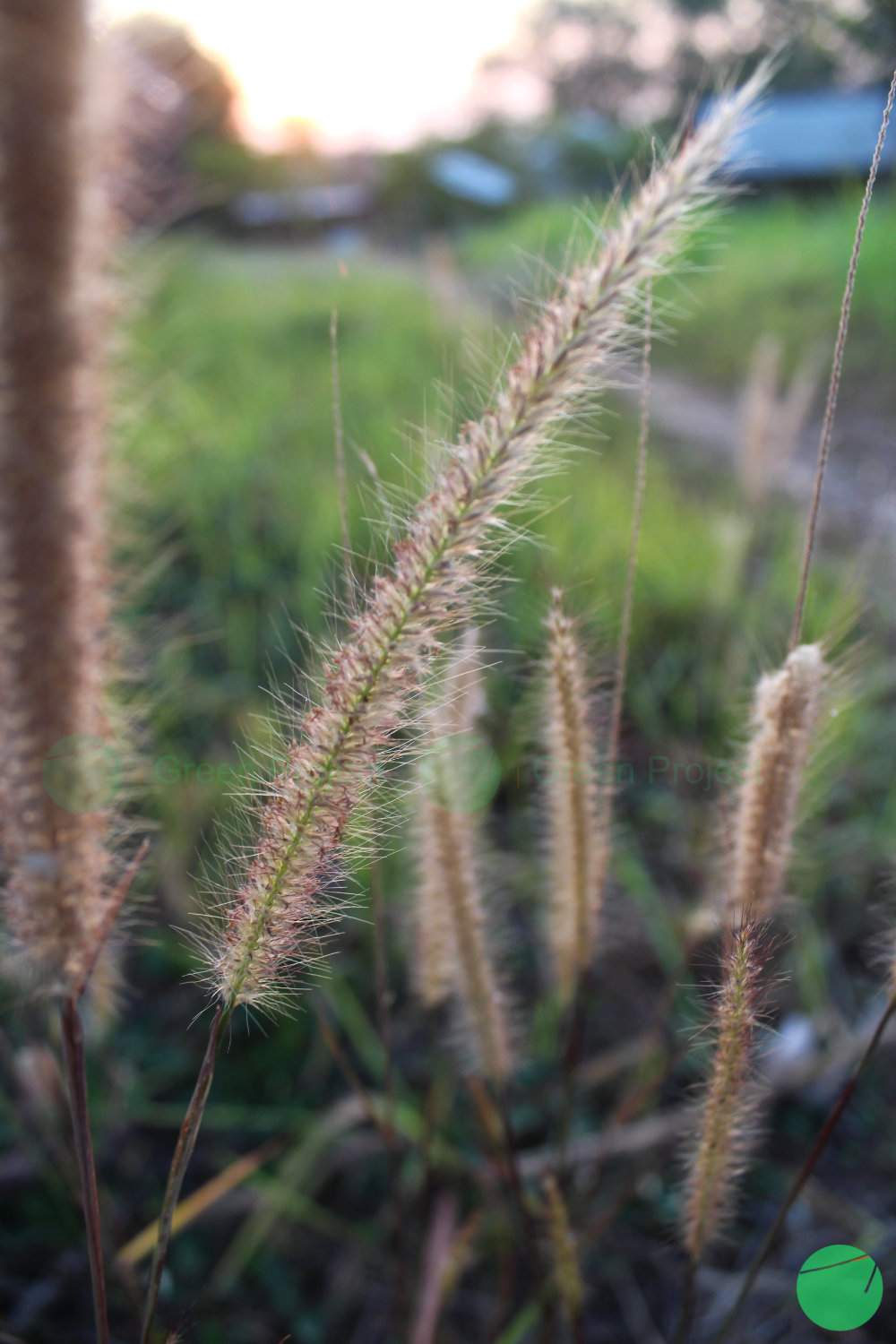
The full extent of this grass species' distribution remains uncertain. Nevertheless, the photographs of the grass featured in this text were taken in the vicinity of Lake Setu Patok, Cirebon.
Morphology and Invasive Trait
Desho grass is a notably aggressive type of grassy weed. It typically invades agricultural land in tropical regions, where its dense and massive spread can become so severe that entire farms may have to be abandoned. The plant spreads rapidly and is difficult to control.
Desho grass is a perennial herbaceous grass with an extensive root system that anchors it firmly into the soil. It possesses a high capacity for biomass production and grows upright, reaching heights of 90 to 120 cm, depending on soil fertility.
Benefits and other Uses of Desho Grass
Although it has been classified as an invasive weed, particularly in the Americas, desho grass is widely used as livestock fodder in Ethiopia. According to Bimrew Asmare (2017), desho grass is a promising forage crop in Ethiopia, capable of providing large quantities of high-quality feed for both smallholder farmers and intensive livestock production systems, provided it is managed correctly.
Furthermore, Bimrew Asmare notes that desho grass can contribute to groundwater conservation and land rehabilitation, as documented by various researchers in Ethiopia. Other sources corroborate these findings, suggesting that desho grass is beneficial for controlling soil erosion and improving the physical and chemical properties of the soil ("Pennisetum Pedicellatum (Deenanath Grass)," 2022).
Location
Bibliography
Cenchrus pedicellatus (Trin.) Morrone | Plants of the World Online | Kew Science. (2023). Plants of the World Online. https://powo.science.kew.org/taxon/urn:lsid:ipni.org:names:77106022-1
Bimrew Asmare. (2017). The potential of desho grass (Pennisetum pedicellatum Trin.) for animal feed and land management practices in Ethiopia: A review. Academia.edu. https://www.academia.edu/85746629/The_potential_of_desho_grass_Pennisetum_pedicellatum_Trin_for_animal_feed_and_land_management_practices_in_Ethiopia_A_review
Pennisetum pedicellatum (deenanath grass). (2022). CABI Compendium. https://doi.org/10.1079/cabicompendium.39769