Slender Amaranth (Amaranthus viridis)

Name
Amaranthus viridis known in Indonesia as bayam raja (king amaranth) or bayam kecil (small amaranth). Internationally, it is commonly referred to as "slender amaranth," "green amaranth," or "African spinach." In the Philippines, it is known as colites, while in India, it is called rajgira or ramdana. In Japan, it is popularly known as aobiyu.
The genus name, Amaranthus, is derived from the Greek a- (meaning "without" or "lacking") and maraino (meaning "to fade"). This implies "unfading," a reference to the durability of the flowers found in several species within this genus. The specific epithet, viridis, is the Latin word for "green" (New Zealand Plant Conservation Network, 2024). Other sources suggest that the genus name originates from the Greek word anthos, signifying an "evergreen flower" (Singhania et al., 2023).
Taxonomy
| Kingdom | Plantae |
|---|---|
| Phylum | Tracheophyta |
| Class | Magnoliopsida |
| Order | Caryophyllales |
| Family | Amaranthaceae |
| Genus | Amaranthus |
| Species | Amaranthus viridis |
Origin
Amaranthus viridis is a plant native to a region extending from southeastern Mexico throughout the tropical Americas—including Argentina, the Bahamas, Belize, Bolivia, Brazil, Haiti, Jamaica, Honduras, Uruguay, Paraguay, and Venezuela (Amaranthus viridis L. | Plants of the World Online | Kew Science, 2014). The plant has since spread extensively across many tropical regions in Asia and Africa.
Morphology
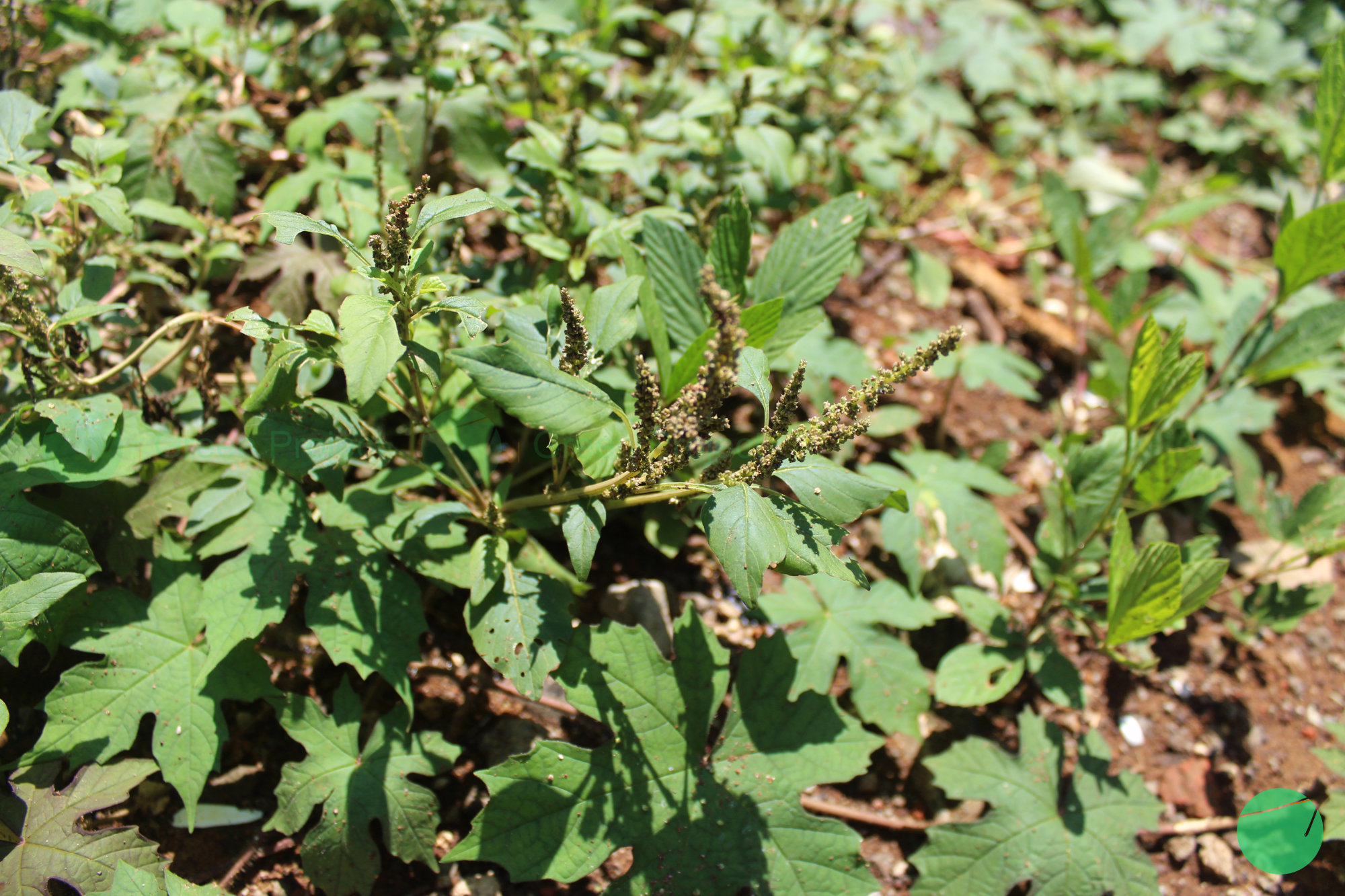
Amaranthus viridis (slender amaranth) is an annual herbaceous plant that can reach a height of 100 cm. This species shares many characteristics with other members of the genus Amaranthus; however, it can be distinguished by its small, sparse perianth segments and broad, rough-textured capsules ("Amaranthus viridis (Slender Amaranth)," 2022).
The flowers of this species grow in dense clusters along the stem. They are small, green, and unisexual.
The green leaves are arranged alternately and have a fibrous surface. They feature long petioles, with leaf blades that are broad at the base and taper toward the tip.
Health Benefits and Other Uses
Bayam raja (king amaranth) is widely utilized as livestock feed, a medicinal ingredient, and a food source for humans. According to a report by Ghifari (2023), bayam raja contains high levels of iron, as well as various secondary metabolites—such as flavonoids, antioxidants, and phenolics—that are beneficial in addressing degenerative diseases.
Research conducted by Ikram et al. (2023) indicates that, due to its diverse pharmacological activities, bayam raja holds promising potential as a therapeutic agent for managing labor pain, skin conditions (such as eczema and psoriasis), and respiratory issues. Furthermore, the plant exhibits antimicrobial effects against bacteria, fungi, and parasites—properties that can be harnessed through solvent extraction, phytochemical screening, isolation, and purification processes.
Bayam raja—also known as rajgira in India—is documented in Ayurvedic medical texts. Traditionally, the plant has been used as a skin cleanser, a remedy for constipation, and a means to manage aging and hair loss (Gupta, 2023).
Location
Bibliography
ACIR Community. (2024). Usda.gov. https://acir.aphis.usda.gov/s/cird-taxon/a0u3d000000UM4gAAG/amaranthus-viridis
Amaranthus viridis L. | Plants of the World Online | Kew Science. (2014). Plants of the World Online. https://powo.science.kew.org/taxon/urn:lsid:ipni.org:names:316349-2
Amaranthus viridis (slender amaranth). (2022). CABI Compendium. https://doi.org/10.1079/cabicompendium.4654
Ghifari, Muhammad Nabil. (2023). Peningkatan Kandungan Zat Besi, Total Fenolik, dan Aktivitas Antioksidan Bayam Hijau (Amaranthus viridis L.) dengan Pupuk Maggot (Black Soldier Fly). Ipb.ac.id. http://repository.ipb.ac.id/handle/123456789/121584
Gupta, S. (2023, November 28). IAFA Ayurveda. IAFA for Allergy. https://www.iafaforallergy.com/superfoods-a-to-z/amaranth-chaulai-amaranthus-viridis/
Ikram, M., Haider, A., & Fatima, U. (2023). Pharmaceutical Activity of Medicinal Plant Amaranthus viridis Linn. Due to Its Chemical Constituents: A Review. Bioeduscience, 7(2), 143--148. https://doi.org/10.22236/jbes/12089
New Zealand Plant Conservation Network. (2024). Amaranthus viridis. New Zealand Plant Conservation Network. https://www.nzpcn.org.nz/flora/species/amaranthus-viridis/
Singhania, N., Kumar, R., None Pramila, Sunil Bishnoi, Ray, A. B., & Diwan, A. (2023). *Bioactive Properties and Health Benefits of *Amaranthus. 351--383. https://doi.org/10.1002/9781119793007.ch10